Showing posts with label art history. Show all posts

Friday, January 25, 2013

The Art of Fresco


Yesterday I had a conversation with a designer friend who was telling me about his office cleanse in which his assistant urged him to toss any magazines he hadn't read in a year. Horrified at the thought, I started flipping through my own endless collection of magazines today as some sort of subconscious justification for keeping them. The justification continued as I came across this photo of the Tuscan estate of Leonardo Ferragamo and his wife, Maria Beatrice in the March 2009 issue of Elle Decor. This living room tells me one thing - we don't use the art of fresco near enough these days. The life that these fresco painted walls bring to the room is overwhelming.

Monday, December 17, 2012

Art Deco in Los Angeles


I went on an architectural walking tour in downtown that focused on Art Deco buildings. I enjoyed every part of it (except for the part where the tour guide would get mad at me for falling behind the group because I was staring too long or taking too many photos). Other than that it was truly inspirational!


Art Deco design has really beautiful and strong characteristics and even though an entire space dedicated to that style might not be my personal taste, incorporating certain Art Deco elements or pieces into an interior can add that extra needed layer. The shape of a building can be inspiration for a custom table, a coiffered ceiling can be adapted to a more contemporary dining room, and metal carvings around a door can be translated into embroidery designs for bedding or pillows. I'm finding that taking things from the past and putting my own spin on them is the best way to create layered and interesting interiors that have depth and are uniquely my own.


Wednesday, May 11, 2011

Alexander Calder @ the OCMA

Photobucket

The new exhibit at the Orange County Museum of Art features the work of beloved artist Alexander Calder along with other contemporary artists influenced by Calder.

After studying to be a mechanical engineer, Alexander Calder later went on to study art and eventually became famous for his miniature circus acts that he would carry in suitcases and perform for audiences. "Cirque Calderfeatured circus performers made from wire, string, rubber, cloth, and other found objects. Thanks to YouTube we have access to Calder's fascinating little circus' at the click of a mouse. 


Alexander Calder is perhaps most famous for creating the mobile. Calder had said, "To most people who look at a mobile, it's no more than a series of flat objects that move. To a few, though, it may be poetry."

Photobucket

Photobucket


Photobucket

Photobucket


And to me...it is poetry. 

Go to the OCMA and see for yourself. The Calder exhibit runs through September 4, 2011.

Monday, March 7, 2011

The British Museum, London


While in London we stopped by the British Museum to see the Rosetta Stone (very cool) and all of their ancient Egyptian and Near East artifacts. Something I was pleasantly surprised to also see at the British Museum was a small collection of drawings from modern artists. I really enjoy looking at the detail of pen or ink drawings where so much attention is given to a simple line.


www.BrittanyStiles.com

Tuesday, February 1, 2011

Google Street View Technology + Art

Nothing will ever beat a first hand experience, but this is still pretty cool. If anything, it can give you a little preview to see what exhibits you would actually be interested in visiting in person.


Find out more at Artinfo.

www.BrittanyStiles.com

Thursday, January 13, 2011

TYPE: A Visual History of Typefaces and Graphic Styles


I thought this book was so noteworthy. I have a little thing for graphic design and just had the chance to look through this comprehensive book on typefaces from 1628-1900 (V.1) and 1901-1938 (v. 2). To leaf through online, go here for vol. 1, and here for vol. 2.


I also found this cool design blog from Birdsong Gregory while searching for more info on the book. Check it out, blog.birdsonggregory.com.

Thursday, January 6, 2011

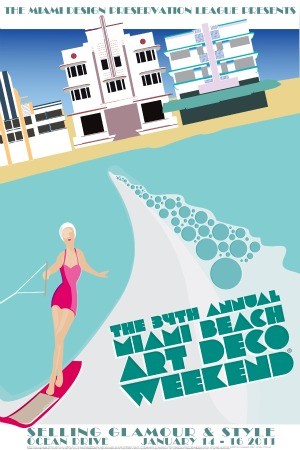
Art Deco Miami


This year my still-single siblings, my parents, and I  threw tradition to the wind, literally, and went on a sailing adventure around the Florida Keys for Christmas. It was so different than the same Christmas that I've been having at home for the past 28 years, but change is good and I had the time of my life.

I could go on and on about the sailing, the manatees, my family's inside jokes, not having a proper shower for 10 days, and what it was like to share a small cabin with my two brothers, but for the blog's sake, I'll keep this design related.

In the middle of our trip, there was a little cyclone that came in to the Keys producing "gale force winds", which prevented us from sailing for a couple of days. We took advantage of this time by renting a car and heading up to Miami. The city did not disapoint and I fell in love with Art Deco during my short stay there, so I wanted to post some photos of some of the beautiful Art Deco buildings. It gives the city a totally unique vibe.


I was bummed we weren't in town 2 weeks later to experience Art Deco Weekend, which will be going on from January 14-16. If you're looking to take a trip this month, I highly recommend you go check it out. Art Deco Weekend has been going on since 1976 and attracts thousands of visitors every year. It's a weekend to promote preservation of Art Deco design in Miami and consists of guided tours, films, antique vendors, music, theater, and dancing. Since I won't be going this year, I've added it to my bucket list!

Sunday, December 5, 2010

Joan Mitchell at the Gagosian

La Grande Vallee XVI, Pour Iva, 1983

Looking at art is a lot like clothes shopping for me. I take a long time to browse and don't like to feel rushed or like someone is waiting for me. I like to stare at things for a long time to decide how I feel about them, move on to the next thing, and then go back to something I've preciously viewed. They are two of my favorite pass times, and for these reasons, I generally prefer to do both alone, so I was a little nervous when two of my guy friends, who aren't really that into art, invited themselves to come along to view Joan Mitchell's exhibit at the Gagosian on Saturday.

Lucky for them they were very well behaved, and lucky for me there were only 13 paintings in the exibit, which means they didn't get too restless.

If you have any interest in abstract expressionist paintings, then you really need to go see this exhibit. The paintings were amazing. Seriously amazing. The Gagosian is in a beautiful part of LA, and the gallery itself is very cool from an architectural stand point. Entrance is free, parking around the corner is free, and it's not a huge time commitment. It's a small gallery and you can stare at the paintings for a long time and still be done in an hour.

Have I sold you on it yet? I've posted some photos of my favorites, and if you want to read LA Times art review go here.

Yves, 1991

Merci, 1992

Monday, November 22, 2010

Post-Impressionist Exhibit @ The de Young

Paul CÉZANNE
Still-life with onions, 1896-98


I knew I would already be in Northern California for Thanksgiving with my family, so I decided to come a weekend early to get in the Elle Decor Showhouse and the Post-Impressionist exhibit at the de Young. The Post-Impressionist masterpieces come from the Musée d’Orsay in Paris and the de Young is the only museum in North America to host the exhibition. Posting photos of my favorite works really doesn't do them justice, so if you have the chance to visit the exhibit from now until January 18, 2011, I would highly recommend it.

My biggest tip for visiting would be to buy your tickets in advance here, and if at all possible, book the first tour of the day, so that there are less people in the gallery when you are trying to view. It was crowded on Saturday (and the worker in the gift shop said it was slow day), so it took a little while to get up to the paintings, and then when we did, we felt a little rushed because you don't want to keep everyone behind you waiting for too long. I really wished I had more time because I really would have liked to look at some of these pieces a little bit longer. Even still, it was a great exhibit. Here were some of my favorites:


Maurice DENIS
Panel for girl's bedroom: October evening, 1891


Henri de TOULOUSE-LAUTREC
The clown Cha-I-Kao, 1895


Redhead (Bathing), 1889


Vincent VAN GOGH
Portrait of the artist, 1887


The poet, 1888

Émile BERNARD
Portrait of my sister, 1888


Breton women with umbrellas, 1892


I snagged these photos from National Gallery of Australia website which hosted the exhibit earlier this year. The site lists every piece in the collection and is a great place to read more information on each of the paintings.

Thursday, November 18, 2010

Art History Thursday - Performance Art

Because of the increased and affordable access to photography, film, and sound; and the ease in which an artist could transport these mediums (records, film, etc.), there was an emergence in Performance Art in the mid-60's. It's a little difficult to properly portray it fully in one brief blog post, but I was pretty fascinated with the concept of Performance Art in which the artist, in a sense, becomes the canvas. Performance art is an exploration of the body; how it relates to space, how the body moves, and our emotions, reactions, and limitations as human beings. Some of it is comical, some is uncomfortable, some shocking, and some is just plain bizarre; which is exactly why I love to call it art.

Some of these Perfomance Art pieces were caught on film and others were performed live in a gallery. Below is a quick sampling of some of the interesting pieces we discussed in class.

Bas JAN ADER
I'm too sad to tell you, 1970


Fall II, 1970


Marina ABRAMOVIC
Rest Energy (with Ulay), 1978


Aaa-aaa (with Ulay), 1976


Chris BURDEN
Shoot, 1971


Five Day Locker Piece, 1971
There is no online video footage, but for his MFA exhibition at University of California, Irvine, Burden confined himself to a campus locker for five days.


I hope you found these as interesting/weird/humorous as I did.

www.BrittanyStiles.com

Thursday, November 11, 2010

Art History Thursday - Minimalism


Minimalism (from the late 50's to 70's) is characterized by a few key elements. Minimalism was...

*Anti-illusionism. Minimalism takes this characteristic of modern art further than any other movement thus far. Anti-illusionism was about looking at paint, canvas, and objects for what they really were. It was a focus on flatness and the confines of an art piece and not alluding to what was beyond that.

*Anti-composition. Minimalist didn't worry about achieving an interesting or unexpected balance and tension, instead there was a focus on repetition and displaying things one right after another.

*Embracing of pre-made materials and fabrication. The artist could act as more of a designer only.

*Shifting awareness from the piece of artwork to the context of the art work, the space surrounding it, and the viewer.

*Avoidance of evidence of the artist's hand or touch in the works.

Below is Frank Stella's Die Fahne Hoch!, 1959. Notice the Minimalist characteristics of anti-composition with the geometric layout and repetition of his lines. It is also very anti-illusionist as the lines of the painting accentuate the rectangular shape of the canvas. The idea is to look at the surface only and nothing beyond that; the viewer gets everything that is intended by just focusing on the surface.


Below is Carl Andre's 144 Pieces of Magnesium, 1969. In the minimalist movement art was taken of the "pedestal" and often plunked right down on the floor, into the space of the viewer, causing the viewer to be more aware of the spatial relationship between himself and the art. This piece was meant to be walked on causing the viewer to become aware of the body's visceral knowledge. In this case, Andre helps demonstrate that our bodies can tell the difference when we walk on different surfaces (e.g. wood flooring vs. magnesium). There is also a clear focus on anti-composition, fabrication, and the vibe that the artist's hand and touch are far removed from this work (because of it's stark quality and the precise lines and lay out).


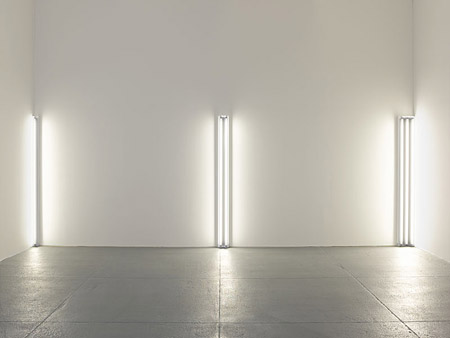
The installation below demonstrates how artist Flavin uses light to emphasize space and spacial relationships, making the art about the space surrounding the work and the space between the work and the viewer more important than the work itself. Also an emphasis on fabrication and anti-composition.


There's so much more I could post on Minimalism, but for the sake of time I wanted to just give a brief introduction. I think it's really fascinating to see the shifts from one movement in Modern art to another and the reasons and feelings behind it all. Every Thursday it's always something new and I love it!

www.BrittanyStiles.com

Tuesday, November 9, 2010

Joan Mitchell - The Last Decade


I seriously can not wait for this! The Last Decade will feature 14 paintings from the last ten years of Joan Mitchell's life. The opening reception is this Saturday, November 13th, from 3 to 5 pm.

Now go get cultured!

You can find more info on the Gagosian Gallery website, here.

www.BrittanyStiles.com
Related Posts Plugin for WordPress, Blogger...